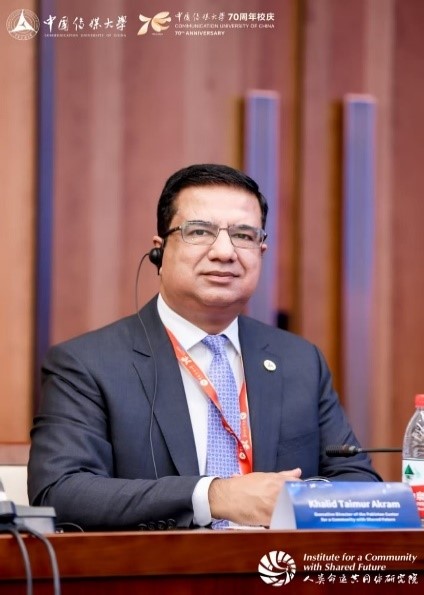
Written by Mr. Khalid Taimur Akram is the Executive Director, Pakistan Research Center for a Community with Shared Future (PRCCSF).
In the heart of Eurasia, a quiet revolution is taking place beneath deserts, mountains, and seas. A revolution made not with armies or borders, but with gas pipelines. This is the story of the Southern Gas Corridor (SGC) often known as the most ambitious energy projects shaping the modern history. This project connects the gas fields of Azerbaijan to the homes and industries of Europe. It is not about energy only, but it also brings Azerbaijan and Caucasus region as a whole closer to the EU both economically and politically.
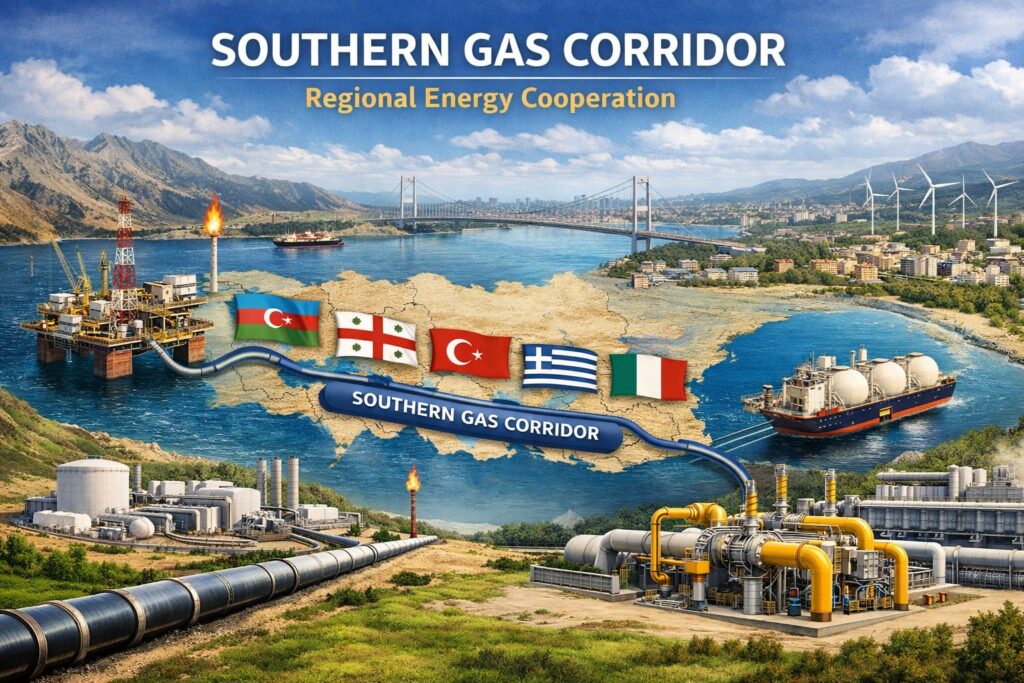
The Southern Gas Corridor, a major gas pipeline project, is an initiative of the European Commission proposed in 2008. This 3500km long transnational energy project is designed to transport natural gas from the Caspian region–primarily Azerbaijan–to European markets. It was basically aimed at reducing the over dependance of European countries on Russia for gas. It is a multi-billion-dollar project that officially began delivering gas to Europe in 2020.
The corridor involves seven countries including Azerbaijan, Georgia, Türkiye, Greece, Albania, Italy, and Bulgaria. It begins in Azerbaijan and brings natural gas from the Shah Deniz field to millions of homes and businesses in Europe. The SGC consists of three main pipelines:
- South Caucasus Pipeline
- Trans-Anatolian Pipeline
- Trans-Adriatic Pipeline
Together, these 3 systems create an uninterrupted energy corridor that connects East and West.
The significance of the SGC lies in its diversification of energy supplies. It is truly a win-win project because whether it be Europe, Azerbaijan, or the transit countries, all are getting benefited. Europe benefits by receiving gas from a new and reliable source. For Azerbaijan, it opens up a new gas market in Europe and strengthen its position as a reliable energy partner. For transit countries, it creates additional job opportunities, the use of local personnel and contractors, as well as potential access to Azerbaijan gas.
A Model of Dedicated Leadership and International Cooperation
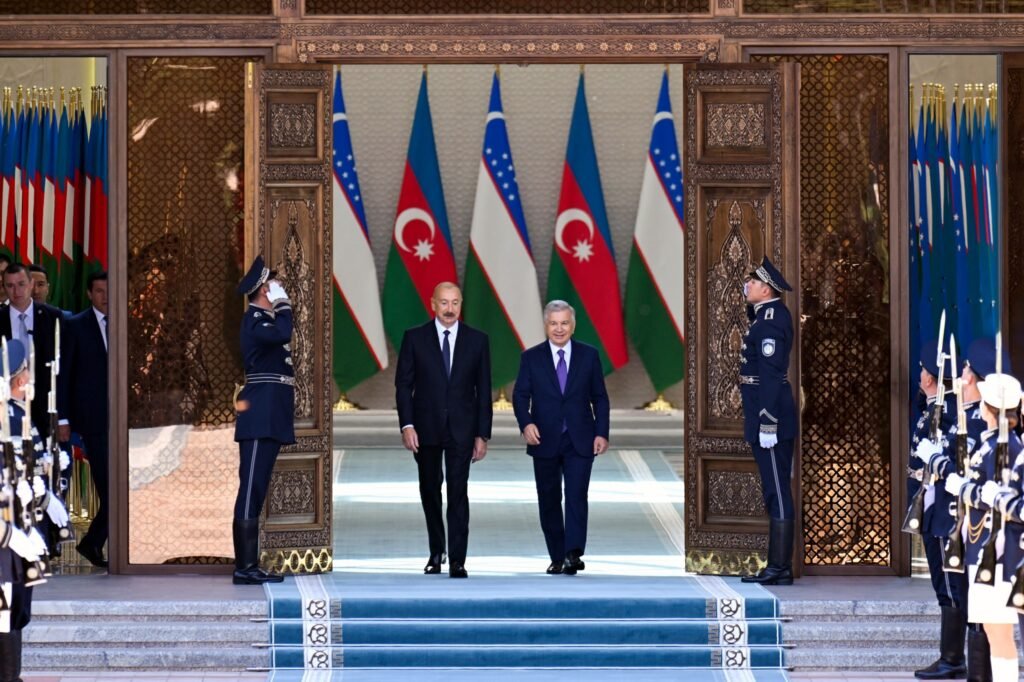
The success of the Southern Gas Corridor did not happen by chance. It is the result of years of negotiations, strong political will, and close cooperation among partner countries. Here, Azerbaijan played a central role from the very start. From taking the initiative to supporting it all the stages, Azerbaijan, under the leadership of His Excellency President Ilham Aliyev, literally showed dedication and commitment to the project. It not only diversified gas supply sources for Europe but also ensure energy security to them. It did so by investing heavily in developing gas fields and building pipeline infrastructure. It is worth mentioning that Azerbaijan did not do it unilaterally, instead, the government also worked with international energy companies and European partners for building a seamless chain and turning vision into reality.
This pipeline network also shows the significance Azerbaijan carries in the global energy market. Thanks to the Southern Gas Corridor, the European Union has identified Azerbaijan as an important pillar of Europe’s post-Russia energy strategy. The European Commission also inked a Strategic Partnership in the Field of Energy with Azerbaijan in 2022. The goal was to double gas exports to the EU to 20 billion cubic meters (bcm) annually by 2027. Moreover, according to reports, in the year 2024, Azerbaijan supplied over 13 billion cubic meters of gas to EU member states (57% increase as compared to 2021). Similarly, in 2026, Azerbaijan is considered one of the top seven natural gas suppliers to Europe. This continued supply of energy, the growing closeness, and the addition of more countries in the network shows the trust world has in Azerbaijan and the steadfast commitment of Azerbaijan in improving the flow of energy.
Türkiye serves as an indispensable transit hub for the Southern Gas Corridor. Its location in Eurasian continent makes it a crucial bridge between energy rich nations and the European markets. It allows the corridor to bypass Russia and supply Europe via the Trans-Anatolian Natural Gas Pipeline (TANAP) and the Trans Adriatic Pipeline (TAP). TAP mostly runs outside the country but TANAP is capable of increasing its capacity to 31 bcm/year, and the Turkish-Greek border serves as the critical entry point for this gas into Europe. Furthermore, Greece, Albania, and Italy have also gained several advantages from the corridor. The corridor provides an alternative source of energy to these countries. It has reduced their dependance on Russia. Infrastructure development has created jobs and improved the economies. Greece and Albania also gain transit revenues from the corridor through TAP while Italy, being an end point, can distribute gas to Western Europe, reinforcing its role as an energy transit and trading hub. That’s why, I called the Southern Gas Corridor as a win-win project.
This cooperation is not limited to governments only. Various international energy companies, financial institutions, and regional organizations have supported the project. Shell, SOCAR, EBRD, EIB, BSCE are some of the notable names here. This indicates that the project is the result of public-private partnership and demonstrates how complex projects can work out through partnership and mutual respect.
Economic Growth, Energy Security, and a Sustainable Future
The Southern Gas Corridor has brought significant economic benefits. First of all, it lessens the reliance of European countries on a single supplier and brings competitive and lower-carbon intensive gas to the market. Multiple supply routes make the energy system more stable and resilient to price fluctuations or other uncertainties. Secondly, the billion dollars investment in partner countries led to employment opportunities, thereby boosting economic growth. For instance, the Southern Gas Corridor provided 12000+ jobs in Greece. It also brings huge welfare gains to consumers in importing countries. The estimates suggest benefits ranging from $54.21–$167.46 billion for the EU and $39.29–$94.84 billion for Türkiye. In the same vein, the transit countries are earning through transit revenue. Since Azerbaijan is the source country, still it is getting benefited. Not only it has become a key global energy player but the corridor has strengthened its economy as well. In Azerbaijan, the oil and gas sector drives almost 40% of GDP. The revenues are then invested in infrastructure, education, and social programs which in turn benefit the local population of Azerbaijan. In addition to this, the corridor also presents Azerbaijan as a trustworthy and responsible supplier in the international community.
If we observe, we come to know that natural gas plays an important role in the global energy transition. Nowadays, renewable energy is in vogue, however, natural gas is still a cleaner and lower-carbon substitute of coal. It means that the Southern Gas Corridor contributes to this transition by providing efficient and modern gas transportation infrastructure with high environmental standards. This corridor holds immense potential. There are many chances of its further expansion. Until now the corridor is confined to the transportation of natural gas only but with the changing realities of the world and the degrading environment, countries are also considering the possibility of transporting renewable gases like hydrogen in the future. Hence, it can be said that this pipeline network is a dynamic project that is not designed for today’s energy needs only but is thinking of tomorrow also.
A Model for Regional Energy Cooperation
Whenever I am asked to give an example of a model of regional energy cooperation, the Southern Gas Corridor comes to my mind. The reason is very simple yet beautiful. This project shows that how shared interests can bring nations belonging to different regions, cultures, and political systems together. Similarly, the Southern Gas Corridor, for the very first time, physically connected the Caucasus region to European markets via 3500 km long and complex infrastructure. Despite the fact that it traverses through many countries and is a result of consortium of more than a dozen international energy companies, the corridor remains a source of peace, stability, and regional prosperity.
In today’s world where energy or oil and gas challenges often come with long term political tensions, the Southern Gas Corridor offers a positive story. It gives us a lesson that dialogue, continued cooperation, and investment can building lasting connections. As discussed earlier, the project has deepened Caspian-European relations and accelerated regional economies as well.
In short, the Southern Gas Corridor is a success story and gives a clear message to the world that regional cooperation works. It tells the world that when countries respect each other, they respect interests of each other, and commit to partnership to achieve common goals, they can create infrastructure like the SGC that serves millions of people.