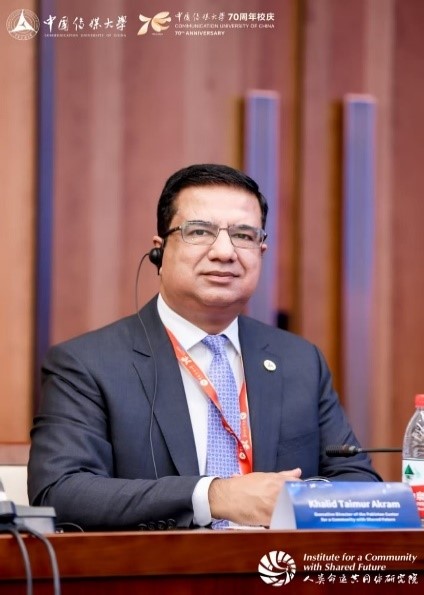
Written by Mr. Khalid Taimur Akram is the Executive Director, Pakistan Research Center for a Community with Shared Future (PRCCSF).
It is economic power that determines political power, and governments become the political functionaries of economic power.
–Jose Saramago
Multiple factors shape the levels of development in any country but economic stability, undeniably, constitutes the backbone of that development. It lays the foundation upon which national prosperity, social welfare, and sustainable growth are built. Political and economic stability are interconnected but economic stability, to a very large extent, determines either country will rise or fall into political chaos. After the restoration on independence in 1991, the Republic of Azerbaijan realized the same thing. The leadership realized the importance of sovereign rights in the economic field. New economic policies were introduced, system was shifted to market economy, and many other efforts were made to recover country’s economy. It didn’t happen over a night. Initial years were marked by total chaos and regression but the national leader of Azerbaijan, H.E. President Ilham Aliyev, did not stop and he lifted the country out of economic instability.
Azerbaijan is located at the crossroads of the South Caucasus region. Its strategic location on the ancient Silk Road further enhances its geopolitical geoeconomic significance. Azerbaijan has always been a small but resource rich country. It had huge reserves of oil and gas but after gaining independence, the country lacked oil-exporting infrastructure. To address this challenge, the leadership of Azerbaijan started working on building modern infrastructure and expanding trade links. Thanks to the foresight and the continued efforts of H.E. President Ilham Aliyev that Azerbaijan now stands as a critical land bridge linking East and West.
Azerbaijan’s Strategic Position and Trade Potential
The economy of Azerbaijan is at a critical inflection point. With a combination of abundant natural resources, a strategic geographic position, and a rich cultural heritage, the nation has the potential to double its gross domestic product (GDP) in the next decade.
As discussed earlier, during the post-independence era, from 1991-1995, Azerbaijan saw economic downfall but the period after 1996 is known for an increase in macroeconomic stability and dynamic economic development. The leadership of Azerbaijan filled the infrastructure gaps by signing agreements for the construction of new corridors and pipelines. To utilize the rich oil and gas reserves, the country began cooperation with international companies in this field. Similarly, they created a business-friendly environment in Azerbaijan to earn the trust of the foreign investors and attract foreign investment. The government enhanced the tourism sector, expanded its trade and transportation links. Azerbaijan’s geographic position at the intersection of Caspian, Central Asian, Middle Eastern, and European markets enables it to serve as a key trading hub.
Azerbaijan has huge trade potential. It is driven by its role as a regional energy hub expanding into non-oil sectors like agriculture, ICT, and transportation. In the year 2024, Azerbaijan’s GDP reached $74.6 billion. The GDP saw a 4.1% increase from 2023. Similarly, in the first half of 2025, Azerbaijan’s total foreign trade turnover reached $24.4 billion. A very interesting fact about this economic growth is that Azerbaijan is earning from both oil and non-oil sectors. It timely realized the importance of non-oil diversification and non-oil sectors like digital economy, renewable energy, Free Economic Zones, logistics, and agriculture constitute a major portion of Azerbaijan’s total economic growth.
In addition to diversification, the government of Azerbaijan has worked hard to broaden its trade relationships. For example, Azerbaijan and Pakistan agreed to enhance cooperation in areas of trade, energy, and air connectivity, including the introduction of business partnerships, direct flights and eased visa regulations. Machike-Thallian-Tarujabba White Oil Pipeline Project, Azerbaijan’s investment in Pakistan, joint military drills, and Azerbaijan purchasing and deploying Pakistan’s JF-17C Block-III fighter jets are few other examples of this brotherhood.
Despite global challenges, Azerbaijan continues to seek new export markets. Its ongoing diplomatic and economic engagement with the European Union and other partners shows that Baku wants to be seen as a reliable and strategic trading partner.
Energy: The Core of Azerbaijan’s Geoeconomic Strength
Azerbaijan’s economic rise owes much to its rich energy resources. The country has been producing energy for more than a century. Its offshore fields in the Caspian Sea, including the massive Azeri‑Chirag‑Gunashli (ACG) oil complex, have made Azerbaijan one of the important global energy producers.
Oil and gas export revenues have been the backbone of Azerbaijan’s economy. The government and state‑owned oil company SOCAR are also collaborating with international partners to develop these resources and expand export capacity. These efforts helped Azerbaijan achieve decades of strong economic growth. Azerbaijan’s role is not limited to being a producer only. It also serves as a transit hub for energy supplies to global markets. Its pipelines carry Caspian oil and gas to Europe and beyond. The Baku‑Tbilisi‑Ceyhan (BTC) pipeline has a capacity of over 1.2 million barrels per day. It moves crude oil over long distances from the Caspian Sea to the Mediterranean Sea in Türkiye, from where it reaches world markets. Alongside BTC, Azerbaijan’s gas exports reach Europe through the Southern Gas Corridor. The Southern Gas Corridor, a major gas pipeline project, is an initiative of the European Commission proposed in 2008. This 3500km long transnational energy project is designed to transport natural gas from the Caspian region–primarily Azerbaijan–to European markets. It was basically aimed at reducing the over dependance of European countries on Russia for gas. It is a multi-billion-dollar project that officially began delivering gas to Europe in 2020.
With the growing importance of non-oil sectors, government is also promoting renewable energy sources such as solar and wind and has set goals to reduce greenhouse gas emissions. The development of renewables is part of a broader long‑term strategy to make Azerbaijan’s energy sector more diverse and future‑oriented.
Connectivity and the Middle Corridor
For Azerbaijan, energy is only part of its geoeconomic strategy. The country is also turning its transport and connectivity infrastructure into a major economic asset. Azerbaijan’s leadership wants to transform the nation into a hub where goods, people, and ideas move easily between Europe and Asia. One of the most ambitious initiatives supporting this goal is the Trans‑Caspian International Transport Route (TITR), often called the Middle Corridor. This corridor stretches from China across Central Asia, through the Caspian Sea and the South Caucasus, and on to Europe. It offers a competitive alternative to traditional northern routes through Russia and southern routes through the Middle East.
The Middle Corridor has already seen significant growth in freight traffic, with millions of tons of goods moving annually. Azerbaijan has invested in railways, highways, logistics centers, and port facilities to handle this increase. These investments make the country a critical logistics hub linking Asia and Europe.
Looking Ahead: Growth, Diversification, and Regional Leadership
Azerbaijan’s geoeconomic future holds many opportunities. Its trade partnerships continue to expand, especially with countries in South Asia, the Middle East, and Europe. Strong diplomatic engagement and new economic agreements are helping bring foreign investment into key sectors such as energy, infrastructure, and manufacturing. The government is also encouraging growth in non‑energy sectors to reduce dependence on oil and gas. This includes manufacturing, tourism, financial services, information technology, and agriculture. Diversification strengthens economic resilience and creates jobs for Azerbaijan’s growing young population.
Azerbaijan has shown that a relatively small country can have a large economic footprint on the world stage. Its unique location, combined with effective leadership, has enabled it to become an energy powerhouse and a vital connection point in global trade networks. As it continues to build world‑class infrastructure and expand key markets, Azerbaijan’s influence in the region and beyond is likely to grow.