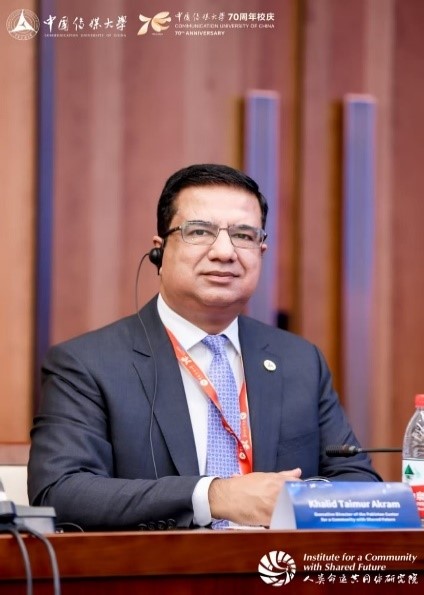
Written by Mr. Khalid Taimur Akram is the Executive Director, Pakistan Research Center for a Community with Shared Future (PRCCSF).
Foreign relations of Tajikistan are usually discussed in terms of security or geography, but in present times, infrastructure diplomacy has become the cornerstone of Tajikistan’s foreign policy. Being a landlocked country surrounded by 90% of mountainous terrain, Tajikistan has always faced challenges related to access to markets, access to ports, trade routes, and connectivity. In these circumstances, Tajikistan saw infrastructure development as the only way through which it could interact with neighboring countries. Among all the five Central Asian states, Tajikistan is the smallest when it comes to land area and its transport infrastructure is comparatively weak also. The mountainous landscape has limited the construction of railways and increased dependence on roads. To address these challenges, Tajikistan started investing in roads, railways, energy, and digital infrastructure. Via all these efforts, it wants to end isolation, strengthen economy, promote regional cooperation, and become a transit hub linking Central Asia with South Asia and China.
We have heard of many forms of diplomacy like economic diplomacy, military diplomacy, backdoor diplomacy but “Infrastructure Diplomacy” is in vogue nowadays.
Now the question is, what is meant by the term “Infrastructure Diplomacy”? Infrastructure diplomacy is a foreign policy strategy where nations support or invest in major projects in other countries. These projects include roads, seaports, railways, energy grids, digital infrastructure, etc. The aims and objectives of infrastructure diplomacy vary from country to country. Some countries use this strategy to expand their influence and promote their own interests, while others to do so to build new partnerships and promote regional integration, while some want to project geopolitical power and dominate their counterparts. Adopting this approach became Tajikistan’s necessity. Taking into account the geographical conditions and the strategic location, Tajikistan opted for connectivity, infrastructure development, and cooperation. It did not go for confrontational policies. It has helped Tajikistan remain on the safer side and cultivate balanced relations in this complex regional environment.
Geography, Connectivity, and Foreign Policy Priorities
Tajikistan’s topography has a profound impact on its foreign policy strategies. It lacks direct access to global markets while countries like Afghanistan, Uzbekistan, Kyrgyzstan, and China border it. This makes Tajikistan highly dependent on regional transport corridors. Therefore, improving infrastructure has become more than just an economic imperative. It is more like a diplomatic need now. This is how Tajikistan will grow its economy and cultivate good relations with partner countries side by side.
Tajikistan’s infrastructure development projects are the classic examples of infrastructure diplomacy. Modern highways that connect Dushanbe to neighboring countries have not only improved trade but have also led to exchange of goods, cultures, and people. The Dushanbe–Khujand highway is a 354 km highway that connects Dushanbe with Khujand, the center of the northern province, and the town of Chanak on the border with Uzbekistan. This highway is a vital economic lifeline of Tajikistan because it bypasses the challenging mountainous terrain via major but hazardous tunnels like the Anzob (Istiqlol) tunnel. Its importance lies in another fact also. It links Dushanbe to Khujand, the 2nd largest city, that facilitates trade and connectivity, particularly with Uzbekistan. It also reduced driving times from 12 hours to 4 hours. So, such projects reflect that Tajikistan is committed to build friendly ties with other countries and is also focused on regional integration.
Since Tajikistan is a small and poor state, so it is facing trouble in financing the infrastructure projects. To resolve this issue, it has worked with international partners also. International development entities, led by the World Bank, Asian Development Bank and the UN’s International Fund for Agricultural Development (IFAD), are providing roughly 97 percent of the financing for the 82 projects launched by Tajikistan. Cooperation with institutions and other multilateral partners shows that Tajikistan believes in multilateral solutions, not unilateral actions and this very approach has enabled Tajikistan earn the trust of the international community.
Tajikistan’s connectivity strategy is not limited to road networks only. There is another pillar called the energy infrastructure. Tajikistan is a resource rich country and has vast water resources. To utilize these resources, it has invested in hydropower. This hydropower not only fulfills the domestic needs but it contributes to regional energy security also. Through this initiative, Tajikistan wants to give a message to the world that in an era where energy projects are being used for competition, we should use them for cooperation.
Energy and Transport as Tools of Regional Cooperation
At the core of Tajikistan’s infrastructure diplomacy lies the hydropower. We often think of dams and cross-border power transmission lines as purely technical projects but that’s not the case. They carry great diplomatic significance since they help in cultivating good relations with other countries. When Tajikistan collaborates with other nations in energy sector, it’s not just about electricity—it’s about shared progress and lasting stability.
Thanks to Tajikistan’s abundant water resources that it is actively trying to become a vital electricity hub that will link South Asia and Central Asia. CASA-1000 Project, Turkmenistan-Uzbekistan-Tajikistan-Afghanistan-Pakistan (TUTAP), GBAO Grid Development, are few examples of Tajikistan’s involvement in regional transmission initiatives. These are aimed at providing surplus energy to neighboring states during peak seasons. Such projects pave the way for governments to have a dialogue with each other, cooperate with one another and also helps in trust building process. Tajikistan doesn’t see energy as a winner-takes-all resource, but as something countries can benefit from, thus harmonizing its foreign policy to cooperation and sustainability.
Transport connectivity also highlights the constructive role of Tajikistan in the region. Cross-border infrastructure projects with China especially those under the banner of the Belt and Road Initiative (BRI), have given Tajikistan improved access to markets and enhanced trade flows also. Better border facilities and logistics routes make it easier for Tajikistan to plug into regional supply chains which helps both the country and its neighbors.
Infrastructure Diplomacy and Tajikistan’s Regional Image
When Tajikistan got independence, Tajik Civil War struck the country. It was a new born state, facing isolation due to its topography, and struggling because of armed conflict, financial situation, weak infrastructure, and so many other problems. Given these domestic conditions, many assumed that Tajikistan would never stand out on the international front but that’s not the case. Tajikistan not only overcame these challenges, it stood out on the global stage, and rebranded itself as an “landlocked” to a “land-linked” country using infrastructure projects. Tajikistan became an “initiator country” for regional cooperation and integration despite facing financial challenges. Thus, infrastructure diplomacy not only helped Tajikistan strengthen its international image but also present itself as a forward-looking state. This approach gives a lesson to the world that building infrastructure is not about physical construction and connectivity only but it also enables countries to build political relationships. Whether it be road, dam, tunnel, pipe line or any other infrastructure, it is the result of long debates and discussions between the governments, negotiations, dialogues, and a number of compromises. This the reason why we call foreign policy of Tajikistan as responsible and practical one.
Conclusion
In my opinion, infrastructure diplomacy has emerged as a central pillar of Tajikistan’s foreign policy. Through all the infrastructure development, on one hand, Tajikistan seeks to overcome its geographical isolation while accelerating economic growth and strengthening multilateral cooperation on the other. Unlike many, Tajikistan has chosen a path will bring stability, shared prosperity, and long-term benefits. Tajikistan’s geography was a challenge but Tajikistan changed it into an opportunity; opportunity for modern infrastructure, opportunity to engage closely with international community, and an opportunity to present itself as a constructive player in the region.