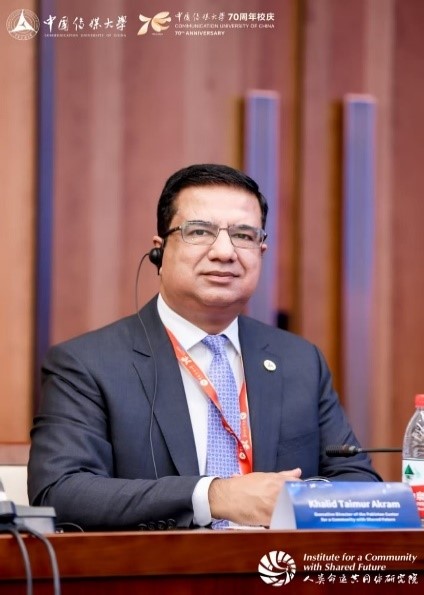
Written by Mr. Khalid Taimur Akram is the Executive Director, Pakistan Research Center for a Community with Shared Future (PRCCSF).,
China’s foreign policy has undergone profound changes over the past several decades. Remarkable transformation can be observed in its foreign policy. After the founding of People’s Republic of China in 1949, under the leadership of Chairman Mao Zedong, China adopted a revolutionary isolationist foreign policy. Chinese foreign policy was centered on ideology. During that time, China prioritized national development. Its relations with major powers were mostly limited or tense. It often viewed Western powers with suspicion. It had its own political goals and was mainly focused on protecting its sovereignty rather than broader engagement with the world. At that time, China viewed itself as a revolutionary socialist state. However, since the late 1970s and the early 1980s, especially since the end of the Cold War, China has made important adjustments in its foreign policy. In late 1970s when Paramount Leader Deng Xiaoping assumed the power, China entered into an era of “reform and opening up”. Paramount Leader Deng Xiaoping transitioned the nation toward a socialist market economy. Under Deng’s leadership, China adopted a pragmatic foreign policy and focused on economic development rather than revolutionary ideology. Paramount Leader Deng’s main goal was to create a stable international environment in China that would help China modernize its economy. Under his leadership, China expanded trade with many countries and also welcomed foreign investment and technology. In simple terms, Paramount Leader Deng used foreign policy as a tool for China’s economic development. This new foreign policy also led to the establishment of formal diplomatic relations between China and the United States of America in 1979. Some other major adjustments in foreign policy included:
- improved ties with Western nations
- reduced dependance on either superpower during the Cold War
- balanced relations with major powers (USA & USSR)
- adopting an “independent foreign policy of peace”
It is worth pointing out that although China improved relations with other countries and expanded trade, still it avoided seeking global leadership. Paramount Leader Deng promoted a cautious approach often summarized by the phrase taoguang yanghui meaning “hide your capabilities and bide your time”. Under this approach, China stayed out of major international confrontations and focused on strengthening country internally. Under Deng’s “low profile” foreign policy, limited political reforms took place but China’s economic growth skyrocketed and Paramount Leader Deng Xiaoping came to known as the “Architect of Modern China”.
Under the Jiang administration, from 1989–2002, China deepened economic opening, kept a low profile, integrated into global institutions and also engaged internationally. China’s foreign policy in the Hu Jintao’s era, from 2002–2012, was closest to that of Paramount Leader Deng. General Secretary Jintao maintained a cautious foreign policy. Like Deng, he also avoided major international confrontations. He also promoted China’s “peaceful rise” and “peaceful development”. While prioritizing economic growth, he expanded China’s international influence.
In 2012, China’s foreign policy witnessed a dramatic shift when His Excellency Xi Jinping assumed the office of General Secretary of the Communist Party of China. Xi’s era is often described as a watershed moment in the evolution of Chinese foreign policy. He came to power during an era of global uncertainties. There were lingering effects of the 2008 global financial crisis, many countries were facing sluggish economic growth, rising geopolitical tensions, and the growing debates about globalization and international governance dominated the scene. In such circumstances, President Xi abandoned the low profile and cautious foreign policy and adopted a more assertive and proactive foreign policy. He pursued two different approaches at the same time, the “major country diplomacy” and the “peripheral diplomacy”. Former led China renounce its passive role and adopt the role of proactive global player while the latter helped China cultivate friendly relations with its immediate neighbors. President Xi inherited a strong and more confident China. At that time, China had already become world’s second largest economy. It occupied a significant position in international affairs and was a major trading partner. Leveraging the global political and economic standing of China, H.E. Xi Jinping changed the country’s role from being just a participant to an active shaper. In his view, if China has already become a major power, it should not merely adapt to the international order—it should help shape it. Therefore, instead of waiting for events to unfold, President Xi started launching major initiatives which are now known worldwide serving as models of development. These include:
- The Belt and Road Initiative (BRI)
- The Global Development Initiative (GDI)
- The Global Security Initiative (GSI)
- The Global Civilization Initiative (GCI)
- The Global Governance Initiative (GGI)
This is how under President Xi’s guidance, Chinese foreign policy evolved from economic development to broader global engagement. In simple terms, this evolution of Chinese foreign policy has culminated in the emergence of a new guiding concept, the concept of “A Community with Shared Future for Mankind (人类命运共同体)”.
A Community with Shared Future for Mankind (人类命运共同体)
The most important idea guiding the China’s modern foreign policy is the concept of A Community with Shared Future for Mankind. The concept was introduced in different stages. After assuming the office of the General Secretary of the Party in 2012, President Xi implicitly put forward the idea of “A Community with Shared Future for Mankind”. He first raised the vision of a global community of shared future when addressing the Moscow State Institute of International Relations in 2013. At that time, phrases like “community of common destiny” were being used. Later on, in 2015, H.E. Xi Jinping, presented the idea at the UNGA. This is when it became clearly defined as: “A Community with Shared Future for Mankind”. In 2017, concept was written into the Communist Party of China Constitution. This is when it became an official guiding principle of the Chinese foreign policy. Hence, we can say the concept was introduced in 3 key stages:
- Birth stage (2013)
- International Recognition (2015)
- Formal Recognition (2017)
Thirteen years ago, the idea was presented as a solution to immense and unprecedented crises humanity has been facing. The Western-led order is characterized by power competition, military alliances, intervention and sovereignty concerns, inequality, and severe dependency on ruling powers. It was creating multi-faceted problems for developing countries and the smaller states. In response to hegemonic liberal international order and to bridge the gap between the powerful and the weaker states and to give voice to the suppressed nations, China put forward the idea of a community with shared future for mankind. It calls for a global order that should be based on equality, win-win cooperation, shared development, mutual benefit, respect for each other’s interests, sovereignty and the territorial integrity.
The concept is based on the belief that all countries are interconnected and their destinies are intertwined. Therefore, global challenges cannot be solved by one nation alone and they require collective solutions. China, under the leadership of President Xi, realized that modern world challenges go beyond traditional threats like wars or military confrontations. They include climate change, health crisis, environmental challenges, cybercrimes, economic uncertainties, and so on. One challenge affects whole humanity. COVID-19 and Ozone depletion are the classic examples. Therefore, China, through its idea of shared community, encourages the nations to work together, respect each other’s differences, and cooperate with each other to fight the global challenges. At the same time, it also promotes the idea that international relations should be focused on cooperation and mutual benefit rather than competitions and zero-sum game. This approach reflects China’s belief that lasting peace and prosperity can only be achieved when all countries have opportunities to develop.
The concept gained international recognition and positive response from international community because unlike international liberal order emphasizing power politics and military alliances, the idea of community with shared future emphasizes dialogue, inclusiveness and win-win cooperation. It offers an optimistic framework for addressing common challenges.
Linking the Evolution of Chinese Foreign Policy with the Community with a Shared Future for Mankind
As discussed earlier, the idea of A Community with a Shared Future for Mankind can be understood as the culmination of China’s long foreign policy evolution. It did not emerge in isolation. The gradual transformation that Chinese foreign policy undergone in the past decades paved the way for the emergence of this concept. Chairman Mao Zedong’s emphasis on sovereignty, independence, and resistance to external domination laid the foundation for the principle of non-intervention in internal affairs of the state and the respect for territorial integrity. Paramount Leader Deng Xiaoping’s policy of reform and opening up integrated China in global economy and demonstrated that international cooperation is crucial for national development. Later on, President Jiang Zemin further deepened China’s engagement with globalization by expanding trade, attracting foreign investment, and participating in global markets. Under his leadership, China also enhanced its engagement with international institutions by entering in WTO and participating more actively in UNO, APEC, and other international and regional organizations. President Hu Jintao promoted the ideas of peaceful development and a harmonious world. Building upon these experiences, President Xi Jinping advanced a broader vision, community with shared future for mankind, in which China seeks not only to benefit from globalization but also to contribute to shaping a more inclusive and cooperative international order.
The moment we start viewing the evolution of China’s foreign policy through the lens of the idea of A Community with a Shared Future for Mankind, we realize that this idea is not just a random concept proposed by Chinese leadership. It actually represents both continuity and change in Chinese foreign policy. It preserves China’s long-standing commitment to sovereignty, peace, and development, while simultaneously expanding China’s role from a participant in the international system to an active contributor to global governance. Through BRI, the four Global Initiatives, and many others, China is actually trying to translate this vision into practical cooperation among nations.